
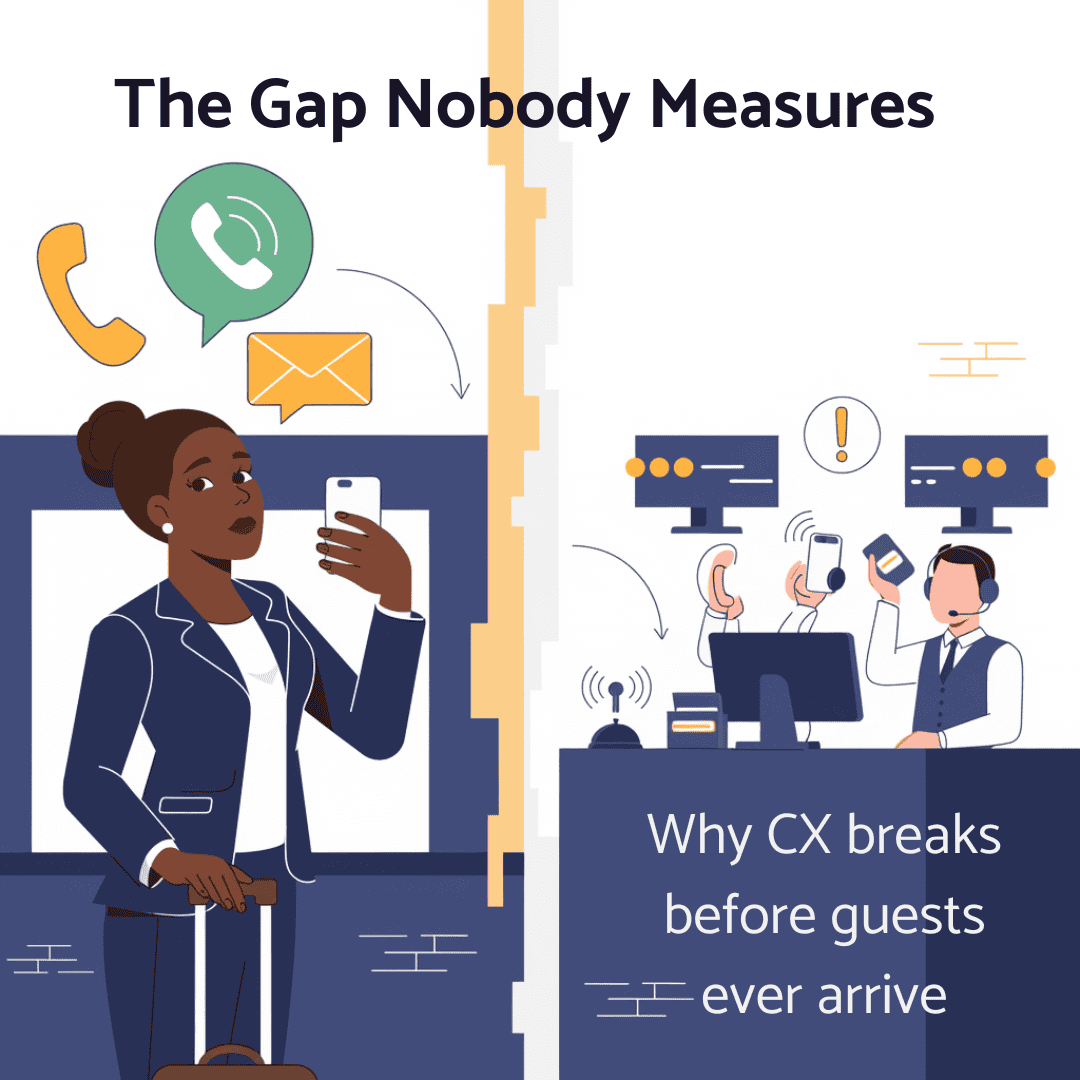
The Gap Nobody Measures: Why Hotel CX Breaks Before Guests Ever Arrive
A guest checks in. The front desk is warm, efficient, exactly as it should be.
Then, almost as an aside, they mention it.
“We were going to book the spa package for our anniversary. Tried to get some information beforehand, but couldn’t reach anyone. We just left it in the end.”
The agent smiles. The moment passes.
But the hotel just lost a sale the guest was already willing to make.
Not because the experience was poor.
Not because the product wasn’t right.
Because nobody was there to answer a question before the moment passed.
The Gap No One Measures
When we talk about guest experience in hospitality, we tend to focus on quality:
- Was the check-in warm?
- Was the room clean?
- Was the service attentive?
All important. All measurable.
But there’s a more critical question that often goes unasked:
Was the hotel available when the guest needed it?
Whether you’re running a 40-room boutique or a 400-room resort group, the pattern is the same. Guest expectations don’t scale with your headcount.
Before a guest ever experiences your brand in person, they interact with you in ways that are far less controlled:
- A phone call before booking
- A WhatsApp message about a late checkout
- An OTA inquiry that arrives at midnight
- A loyalty member with a special request before arrival
And this is where the breakdown happens.
Where CX Actually Breaks
Hotels are designed for in-person excellence.
But guest expectations don’t operate on a front desk schedule.
They happen:
- During peak check-in windows
- After hours
- Across multiple channels at once
- At the exact moment your team is busiest
So what happens?
Calls go unanswered.
OTA messages sit without a reply, costing you both ranking and bookings.
WhatsApp requests go cold.
Front desks get overwhelmed.
Not because teams don’t care.
But because they don’t have the capacity to keep up with demand in real time.
The Cost of Being Unavailable
Every missed interaction has a cost.
Sometimes it’s immediate:
- A lost booking
- A missed upsell
- A guest who never converts
Sometimes it shows up later:
- Frustration before arrival
- Increased pressure at check-in
- Inconsistent brand perception
But it all adds up to the same thing: revenue lost in moments that were never managed.
If a guest can’t reach you, they won’t wait.
Why Most Fixes Miss the Mark
The typical response is predictable:
- Hire more staff
- Add another system
- Push more responsibility onto the front desk
A PMS doesn’t answer phones.
A CRM doesn’t handle WhatsApp at 2am.
And a chatbot that can’t escalate to a human doesn’t build loyalty. It erodes it.
The front desk team is talented, trained, and genuinely cares. But they were designed for in-person excellence, not omnichannel availability. Asking them to manage phones, emails, WhatsApp, OTA messages, and in-person guests simultaneously isn’t a staffing problem.
This isn’t a staffing problem.
It’s a system design problem.
More people doesn’t fix inconsistency.
More tools don’t fix fragmentation.
More responsibility doesn’t create more time.
Ask a Different Question
Will Guidara has said that the human desire to be cared for never goes away. He’s right.
But being cared for has a prerequisite: availability.
For years, our industry has asked: “Are we delivering great service?”
The better question might be: are we consistently reachable when our guests need us?
A Shift in Thinking: From Service to Orchestration
What’s needed isn’t more activity. It’s better coordination.
The most effective operations don’t just deliver service. They orchestrate it. That means:
- Every guest interaction is acknowledged immediately
- Simple requests are handled without delay
- Complex needs are routed to the right person
- No channel is left unmanaged
From the guest’s perspective, it feels seamless.
Behind the scenes, it’s anything but simple.
But that’s the point. The complexity should live in the system, not in the guest experience.
What “Better” Looks Like in Practice
Let’s go back to that 6:42pm call.
This time, the call is answered instantly.
A straightforward question is resolved in seconds. A more complex request is routed to a live agent without friction.
No waiting.
No uncertainty.
No drop-off.
The guest moves forward with confidence. And the hotel captures the moment.
The Role of AI and Where It Fits
There’s a lot of conversation about AI in hospitality right now. Some of it is useful. Much of it is noise.
Will Guidara understood that in any great hospitality experience, the food, the room, and the design are simply ingredients in the recipe of human connection. The same is true of AI.
AI isn’t here to replace human service. It’s here to ensure that service is always available, keeping the door open for those human moments.
- It handles volume across channels
- It eliminates wait time
- It creates consistency at scale
So that when human interaction is needed, it can happen where it matters most.
Because great hospitality will always be human. But availability at scale requires something more.
That’s the difference between automation and true operational design.
From Reactive to Intuitive
But the real opportunity goes further than simply being available.
The best hospitality doesn’t just respond to what guests ask for. It anticipates what they need before they think to ask.
Every returning guest carries a history. The room preference. The early breakfast. The extra towels they always request at check-in.
In a well-run independent property, a sharp front desk manager might remember these things. But at scale, across multiple properties and thousands of guests, that kind of intuitive care becomes almost impossible to deliver consistently.
This is where AI changes the game.
By drawing on guest data at the point of booking, the Tyme Global platform creates automated workflows that translate preferences into action. A repeat guest who always requests extra towels doesn’t need to ask again. A ticket is raised automatically. Housekeeping stocks the room before arrival. The preference is flagged for daily replenishment throughout the stay.
The guest notices nothing unusual.
Except that the hotel somehow already knew.
That feeling of being genuinely seen and cared for, without having to ask, is what separates a good hotel stay from one a guest tells people about.
It’s not magic. It’s the right system, working quietly in the background, so your team can focus on the moments that matter most.
A Different Way to Measure CX
For years, we’ve asked: “Are we delivering great service?”
But the better question might be:
Are we consistently reachable when our guests need us?
Because the hotels that win won’t just deliver exceptional experiences. They’ll eliminate the gaps where experiences never happen.
Final Thought
Most guest experience strategies focus on improving what happens.
Very few focus on ensuring something happens in the first place.
That’s the opportunity.
Not to work harder.
But to design systems that make great service possible every time, across every channel, for every guest.
If you’re evaluating how to close the availability gap across voice, messaging, and digital channels, we’re happy to share how leading hospitality teams are solving this today.
About Tyme Global
At Tyme Global, we’ve built our platform specifically for this gap in hospitality, ensuring that no guest interaction goes unanswered, at any hour, across any channel. If you’re a GM, CX leader, or operations director looking to close the availability gap in your property, we’d love to talk.
About Jacob Robfogel
Jacob Robfogel is Chief Innovation Officer at Tyme Global, a hospitality guest services technology company helping hotels and resort groups deliver seamless, personalised guest experiences across every channel. With a background spanning hospitality operations, technology, and customer experience strategy, Jacob works with properties around the world to close the gap between great service intent and the systems that make it consistently possible.

